

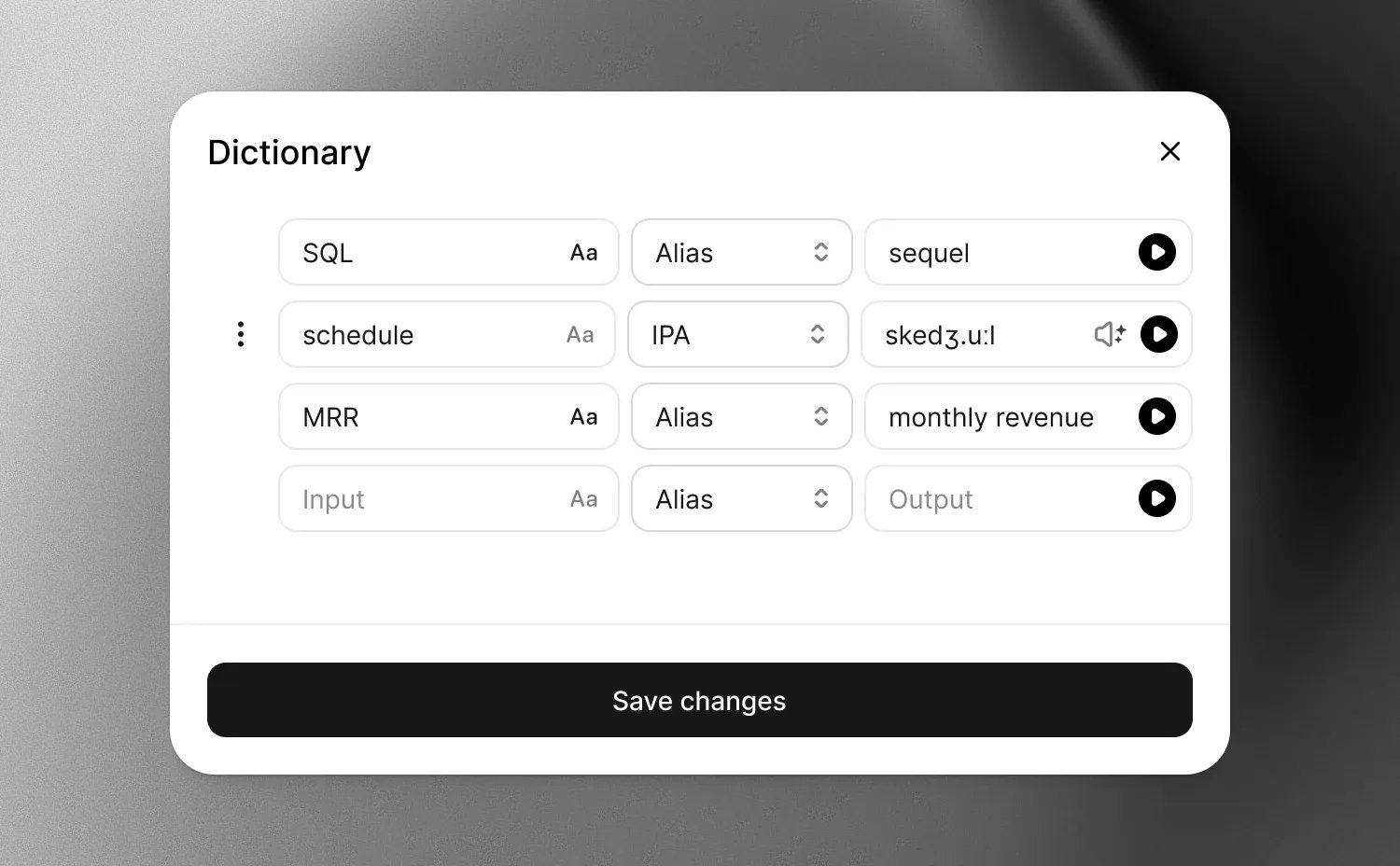
Add a pronunciation
1
Open Dictionary
Open a guide and select Steps. Choose the voice you want to use, then click the
Dictionary book button in the panel footer.
2
Enter the word or phrase
Type the text as it appears in your transcript into Input. A new blank row appears as you
fill in an entry.
3
Choose how it should sound
Select Alias for an alternative spelling or IPA phoneme for phonetic notation, then fill
in Output.
4
Preview and save
Click the play button beside Output to hear the entry with your selected voice. Adjust it if
needed, then click Save changes.
Each workspace has one shared dictionary, with room for up to 500 entries.
Choose Alias or IPA
Start with Alias when a spelling change is enough. Use IPA phoneme when you need more control over the sounds or stress.
For IPA, enter the symbols directly, without surrounding slashes or brackets. Separate words with spaces.
Describe how it sounds
You do not need to write IPA yourself. Select IPA phoneme, then click Describe how it sounds beside Output. Describe the pronunciation in plain language. For example, forread, enter “Sounds like red, rhymes with bed.” You can also describe syllables, stress, or an accent.
Guideless fills in the IPA pronunciation. Play the preview and adjust the description if the result needs another pass. Click Save changes when it sounds right.
Control which text matches
Entries match whole words or phrases, so a rule forapp does not change application.
Matching ignores capitalization by default. Turn on Case sensitive beside Input when capitalization matters. For example, a rule for US can apply to the acronym without changing us in a sentence.
If entries overlap, the longest matching phrase takes priority. A rule for Guideless AI takes priority over a rule for Guideless at the same place in the transcript.
Each rule applies wherever its text matches. If the same word needs different pronunciations in different sentences, use a longer phrase as the input to make the rule more specific.
Update or remove an entry
Open Dictionary again to edit an entry. To remove one, open its Rule actions menu and choose Delete rule, then click Save changes. If you close the dictionary with unsaved edits, choose Keep editing to return to the draft or Discard changes to close without saving. If saving reports that the dictionary changed, another editing session has saved a newer version. Copy any draft changes you want to keep, then close and reopen the dictionary before editing again.Apply changes to a guide
After saving, click Generate voiceover in Steps to use the updated dictionary. Saving a dictionary does not change existing audio or generation already in progress. Regenerate voice-over in each guide that needs the new pronunciation before sharing or exporting it.Up next
Narration
Edit transcripts, choose a voice, and generate voice-over.
Share the guide
Publish the guide with a link or embed.